Playful, yes. Rigorous, always.
OUR APPROACH
We don't just run fun activities and hope for the best. Every experience we design is grounded in established learning science - frameworks that have been tested, refined, and proven to make learning stick and be transformative. Here's what sits behind the scenes.
Experiential learning is what happens when students stop being spectators and start being participants. It's hands-on, reflective, and built around real experience - not slides and note-taking. When students do something, feel something, and make meaning from it together, the learning sticks.
01 / FOUNDATION
The Experiential Learning Cycle
Our foundation is David Kolb's Experiential Learning Cycle - built on the work of educational philosopher John Dewey, who argued that meaningful education and lived experience are inseparable. It's iterative, not a one-off: the reason our programs build understanding that lasts, not just moments that feel good.
Experience
Do something real. A challenge, a simulation, a group task - something that requires active participation, not passive listening.
01
Reflect
Press pause. What happened? What worked? What didn't? This is where the learning actually begins.
02
Conceptualise
Connect the dots. Link the experience to broader ideas, frameworks, or principles. The "aha" moment.
03
Apply
Run it back. Take what you've learned and use it - in the next activity, the next day, the next term.
04
02 / FLOW & ENERGY
Learning Arches
A framework developed by Simon Kavanagh that maps the arc of a learning journey. This is how we avoid the most common trap in experiential programs: lots of energy, no landing
Set
The call to adventure. We prime thinking, spark curiosity, and create the conditions for people to lean in.
Hold
The deep work. Participants explore, experiment, get stuck, and break through - the zone where real growth happens.
Land
The meaning-making. We slow down, reflect, and distil what matters - so the experience doesn't evaporate.

03 / DIALOGUE
Socratic Circles
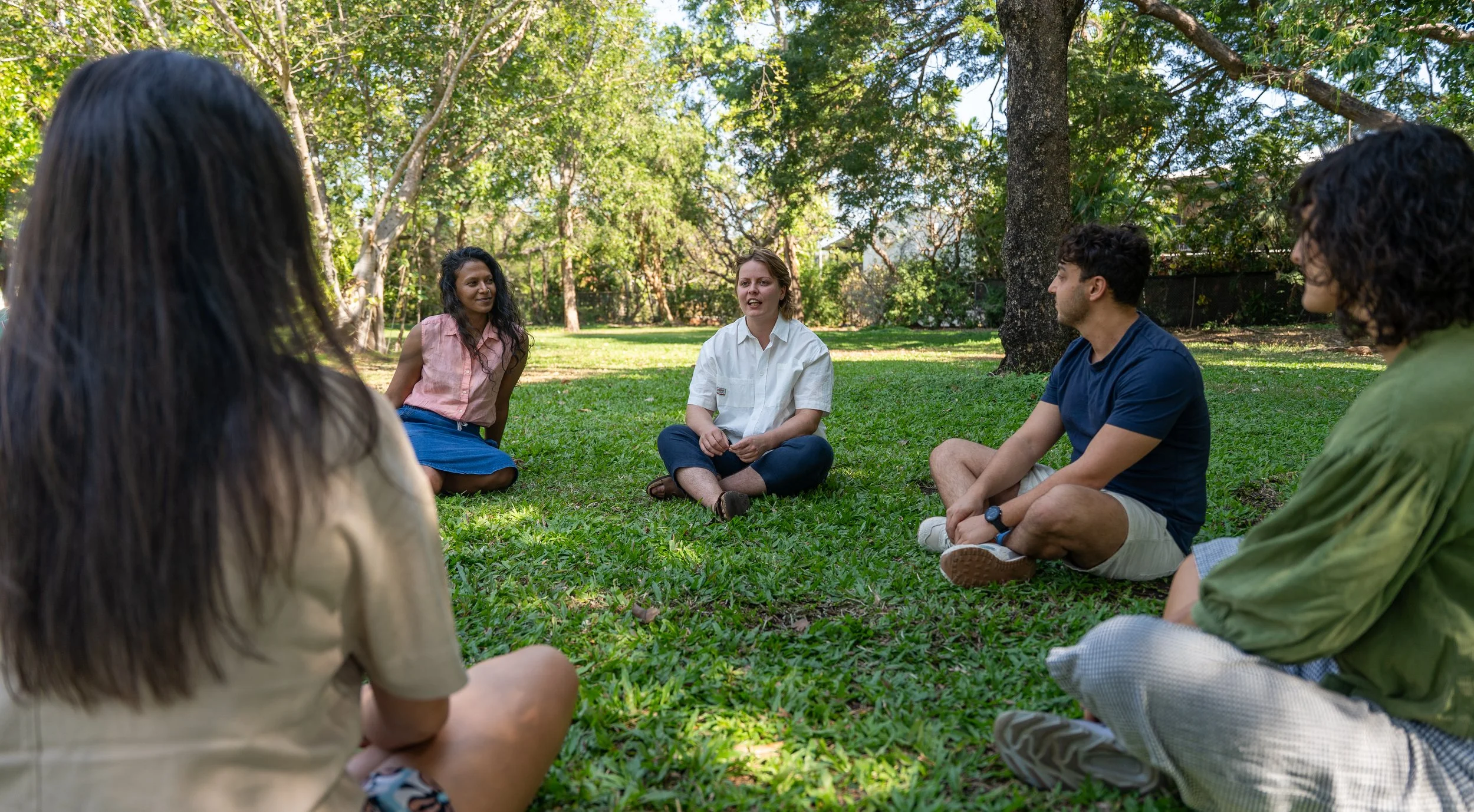
When we want to build critical thinking, perspective-taking, and genuine dialogue, we use Socratic Circles - structured discussions where students wrestle with big questions, challenge assumptions, and learn from each other.
No lectures. No "right answers." Just rigorous, facilitated inquiry.
We use this across leadership programs, transition experiences, and anywhere we want students or students to move beyond surface-level conversation.
04 / THE EVIDENCE BASE
The frameworks above aren’t just good ideas
They're backed by a substantial body of research.
Active learning works.
A landmark meta-analysis by Freeman et al. (2014), covering 225 studies, found that active learning significantly improves student performance and reduces failure rates compared to traditional lecture-based instruction. When people participate, they learn more.
Inquiry drives deeper understanding.
Research on inquiry-based pedagogy shows that learners who investigate, question, and construct their own understanding develop stronger conceptual knowledge and better problem-solving skills than those who receive information passively. Inquiry is the engine of every program we design.
Learning in groups.
People learn effectively through interaction, collaboration, and shared experience. Our programs are inherently group-based - because that's where the richest learning happens. As students tackle shared challenges, they build trust, strengthen connections, navigate different perspectives, and co-create meaning that no individual could reach alone.
Reflection makes it stick.
Metacognition research consistently shows that learners who reflect on their own thinking learn more effectively and retain more over time. This is why structured reflection isn't an add-on in our programs - it's built into every session through Kolb's cycle and the "Land" phase of every learning arch.
Emotion and movement strengthen memory.
When learning involves emotional engagement and physical activity, it activates more regions of the brain, strengthening neural pathways and improving recall. Research by Dr Stuart Brown (National Institute for Play) shows that well-structured play enhances neural connectivity, builds social-emotional competence, and lowers stress. This is why our programs move, challenge, and surprise - not because it's flashy, but because it's how brains work.
05 / ALIGNMENT
Alignment with curriculum and teaching frameworks
Our approach isn't separate from what schools are already doing - it maps directly to the frameworks they're working with.
High Impact Teaching Strategies (HITS) & Teaching for Impact framework
Our programs align with multiple HITS, including collaborative learning, metacognitive strategies, differentiated teaching, multiple exposures, and questioning. These aren't add-ons - they're embedded in how we design every experience.
Australian Curriculum General Capabilities
Our work develops the capabilities that sit across all learning areas - particularly Personal and Social Capability, Critical and Creative Thinking, Ethical Understanding, and Intercultural Understanding.